In the timeless dance of the cosmos, Lord Shiva as Nataraja performs the Tandava—a powerful dance that embodies the eternal cycle of creation, preservation, and destruction.
This cosmic rhythm, the pulse of life itself, finds a profound reflection in the ancient craft of Nizamabad Black Pottery.
From the creative spin of the potter's wheel, where shapeless clay is transformed into form, to the intense fire of the kiln, where the vessel is reborn with its iconic black finish, the entire process mirrors Shiva's divine dance. The symbolism of Nataraja—with the drum of creation, the flame of destruction, and the promise of liberation—is not merely mythology. It lives on through the hands of the Prajapati artisans of Azamgarh.
This is the story of how clay, fire, and craftsmanship echo one of Hinduism's most profound philosophies.
The Cosmic Dance of Shiva: Understanding the Tandava
The Tandava is far more than a dance.
It represents the five fundamental acts of divine energy:
-
Srishti — Creation
-
Sthiti — Preservation
-
Samhara — Destruction
-
Tirobhava — Illusion
-
Anugraha — Liberation
As Nataraja, the Lord of Dance, Shiva performs this cosmic cycle continuously, reminding us that nothing in existence is static. Everything is constantly being created, transformed, and renewed.
The Symbolism of Nataraja
The image of Nataraja is one of the most powerful symbols in Indian philosophy.
Every element carries meaning.
The Ring of Fire
Shiva dances within the Prabha Mandala, a circle of fire representing:
The Damaru: The Sound of Creation
In his upper right hand, Shiva holds the Damaru, the sacred drum.
Its rhythm symbolizes:
The Flame of Destruction
In his upper left hand burns Agni, the sacred fire.
This flame represents:
-
Destruction
-
Transformation
-
Renewal
For in Hindu philosophy, destruction is never an end—it is the beginning of something new.
Fearlessness and Liberation
Shiva's lower right hand displays the Abhaya Mudra, offering protection and reassurance.
His lower left hand points toward the raised foot, symbolizing:
Triumph Over Ignorance
Beneath Shiva's feet lies Apasmara, the demon of ignorance and ego.
His defeat represents the victory of wisdom, self-awareness, and spiritual awakening.
The Potter's Wheel: A Dance of Creation
Just as Shiva's Damaru begins the process of creation, the potter's wheel marks the beginning of a vessel's journey.
The artisans of Nizamabad start with nothing more than a lump of clay.
With patience, rhythm, and practiced skill, they transform the earth into elegant forms:
-
Vases
-
Bowls
-
Mugs
-
Decorative vessels
-
Planters
This stage reflects Srishti—the act of creation.
As the wheel spins, the potter enters a focused, almost meditative state. Every movement matters. Every touch shapes the future form.
The wheel itself becomes a dance.
A dance between human hands and natural material.
The Kiln: The Ring of Fire and the Dance of Destruction
The most dramatic transformation occurs inside the kiln.
This is where Nizamabad Black Pottery undergoes its own Tandava.
The kiln becomes the artisan's version of Shiva's cosmic ring of fire—a place where destruction and rebirth occur simultaneously.
The Process of Reduction Firing
The distinctive black finish of Nizamabad pottery emerges through a traditional technique known as reduction firing.
The process involves:
-
Carefully shaping the clay.
-
Engraving intricate decorative patterns.
-
Placing the pottery inside a sealed kiln.
-
Trapping smoke within the firing chamber.
As oxygen levels decrease, a carbon-rich atmosphere develops.
This intense environment fundamentally changes the clay.
The original color disappears.
A deep black surface emerges.
What appears destructive is actually transformative.
Samhara: Destruction as Transformation
This stage perfectly reflects Samhara, the destructive aspect of Shiva's Tandava.
The fire and smoke do not destroy the pottery.
They destroy what the pottery used to be.
In doing so, they create something entirely new.
The vessel emerges from the kiln:
-
Stronger
-
More refined
-
Richly textured
-
Distinctively black
Just as Shiva destroys to renew, the kiln transforms ordinary clay into a timeless work of art.
The Finished Piece: Preservation and Release
After cooling, the pottery enters a state of Sthiti—preservation.
The form created on the wheel and transformed by fire now becomes stable and enduring.
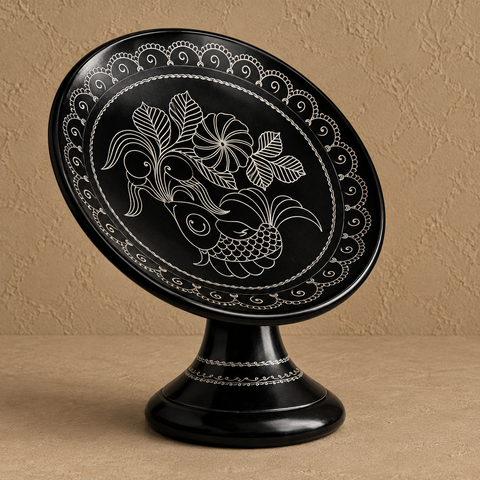
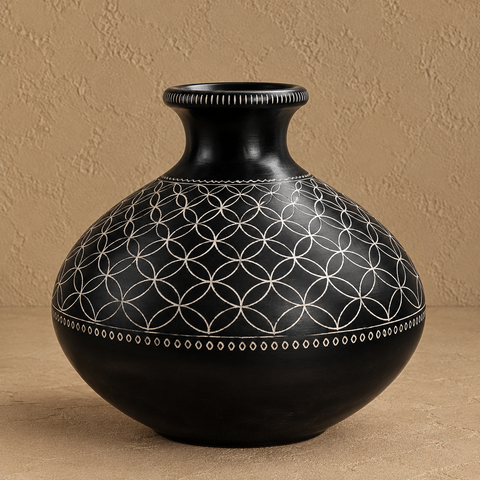
The intricate engravings stand out beautifully against the black surface, creating the signature appearance that makes Nizamabad Black Pottery so distinctive.
But there is another stage reflected here as well.
Anugraha: The Gift of Release
The finished piece is finally released:
It begins a new journey.
It enters homes.
It becomes part of daily rituals.
It carries stories forward.
In this way, every finished vessel embodies Anugraha—the blessing of liberation and fulfillment.
Bringing the Cosmic Dance into Your Home
The philosophy of the Tandava teaches us that transformation is not something to fear.
Every ending creates space for a new beginning.
Every challenge holds the possibility of renewal.
Every act of destruction can become an act of creation.
This philosophy lives within every piece of Hands of Craft's Nizamabad Black Pottery.
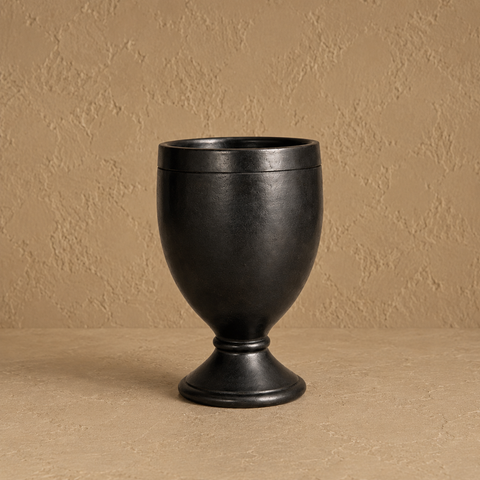
Whether it is a vase, a serving bowl, a planter, or a handcrafted mug, each piece has undergone its own journey of creation, transformation, and rebirth.
It has been shaped by skilled hands.
Tested by fire.
Refined by time.
And preserved as a lasting expression of heritage.
More than a decorative object, it is a piece of Human Time, Preserved—a tangible connection to an ancient tradition that continues to thrive in the present day.
By bringing Nizamabad Black Pottery into your home, you are not simply acquiring a handcrafted object.
You are welcoming a story.
A philosophy.
A tradition.
And a small reflection of Shiva's eternal cosmic dance.