The Maha Kumbh Mela, the largest spiritual gathering on Earth, finds its symbolic and literal origin in the Kumbh, or sacred pitcher, which held the nectar of immortality during the mythological Samudra Manthan (Churning of the Ocean).
This ancient vessel—a humble clay pot—represents the fundamental principles of life, containment, and divinity in Hindu philosophy. It plays a central role in rituals as the Purna-Kumbha, a symbol of cosmic abundance and the womb of creation.
This sacred tradition of revering the earthen pot continues through the master artisans of the Prajapati community in Nizamabad, Azamgarh, whose GI-tagged Black Pottery preserves both the form and spirit of the ancient Kumbh.
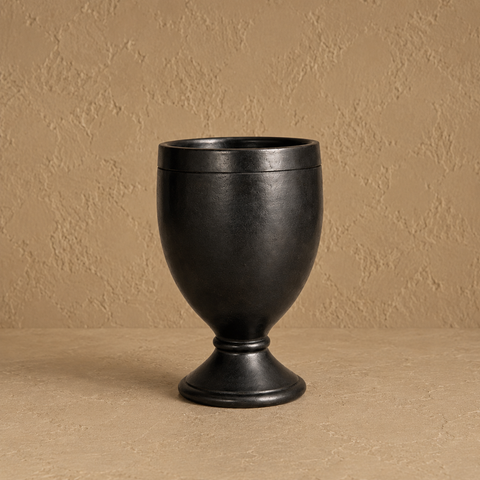
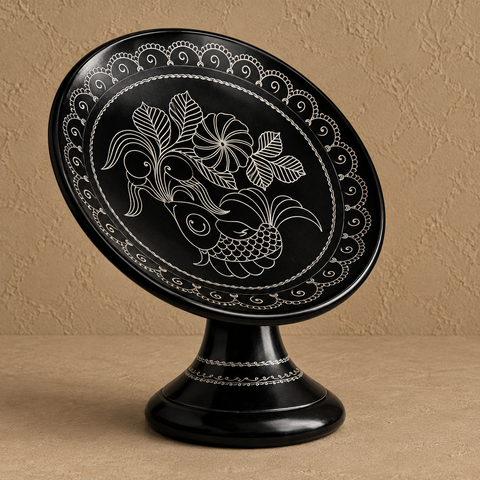
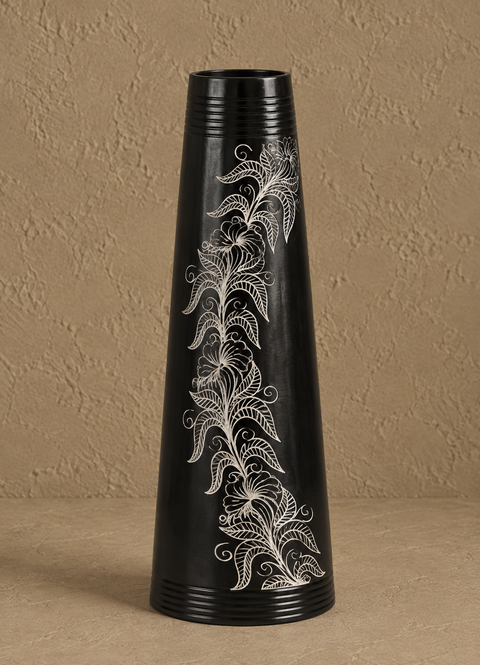
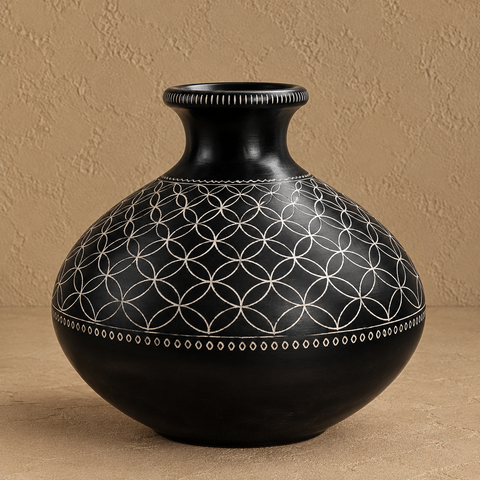
Using a unique reduction-firing technique in sealed kilns, artisans create pottery with a lustrous black finish and delicate silver-grey engravings. From decorative vases and bowls to planters and serving ware, these pieces are more than handcrafted objects—they are living expressions of a tradition that has endured for centuries.
The Divine Origin: The Kumbh and the Churning of the Ocean
The story of the Kumbh begins not with a festival but with one of Hinduism's most important cosmic events—the Samudra Manthan, or Churning of the Ocean of Milk.
Narrated in the Bhagavata Purana, Mahabharata, and Vishnu Purana, this myth forms the foundation of the Kumbh Mela tradition.
What is the Samudra Manthan?
When the Devas (gods) lost their strength and immortality due to a curse, they sought guidance from Lord Vishnu. He advised them to churn the cosmic ocean to obtain Amrit, the nectar of eternal life.
Because the task was too great for the Devas alone, they formed an uneasy alliance with the Asuras (demons).
Together they used:
-
Mount Mandara as the churning rod
-
Vasuki, the serpent king, as the churning rope
As the ocean was churned, numerous divine treasures emerged. Yet the ultimate prize was the Amrit itself.
The Role of the Sacred Pitcher
When Dhanvantari, the divine physician, emerged from the ocean, he carried the Amrit in a sacred Kumbh—an earthen pitcher.
Its appearance sparked a fierce battle between the Devas and Asuras.
According to tradition, during this celestial struggle—which lasted twelve divine days (equivalent to twelve human years)—drops of the nectar fell upon four locations:
-
Prayagraj
-
Haridwar
-
Ujjain
-
Nashik
These places became the sacred sites of the Kumbh Mela, forever connected to the promise of spiritual liberation and immortality.
The Kumbh Mela: A Pilgrimage of Faith
Named after the sacred pitcher, the Kumbh Mela is one of the world's largest gatherings of faith.
Millions of pilgrims assemble along sacred rivers to bathe in their waters, believing that doing so cleanses past sins and helps free the soul from the cycle of rebirth.
Spiritual Significance of the Festival
The Kumbh Mela is far more than a religious event.
It represents:
The presence of saints, ascetics, scholars, and devotees creates an atmosphere of profound spiritual energy. The festival's timing is determined by specific astrological alignments believed to enhance spiritual practices, meditation, and self-reflection.
The Symbolism of the River and the Pot
In Hindu thought, rivers are living goddesses and sources of purification.
Similarly, the Kumbh symbolizes:
Just as the pot holds sacred water, the body holds the soul. Together, the river and the pot symbolize the union of the individual self with the universal consciousness.
The Earthen Pot in Hindu Ritual: A Vessel of Life
The significance of the clay pot extends far beyond the Kumbh Mela.
For centuries, it has remained one of the most powerful symbols in Hindu rituals, representing both the sacredness and impermanence of life.
The Purna-Kumbha: Symbol of Abundance
In Hindu ceremonies ranging from weddings and festivals to daily worship, the Purna-Kumbha (or Kalasha) occupies a place of honor.
Traditionally, it consists of:
-
A clay or metal pot
-
Filled with water
-
Topped with mango leaves
-
Crowned with a coconut
This sacred arrangement symbolizes:
-
Divine presence
-
Prosperity and abundance
-
Fertility and creation
-
The cosmic womb
The water inside represents the primordial waters from which all existence emerged.
From Birth to Death: The Pot's Lifecycle
The earthen pot accompanies individuals throughout life's journey.
It appears in:
-
Birth ceremonies
-
Housewarming rituals
-
Weddings
-
Religious festivals
-
Funeral rites
During cremation ceremonies, the breaking of a clay pot symbolizes the release of the soul from its earthly vessel.
This powerful act reminds us that the body, like the pot, is made from the earth and ultimately returns to it.
Azamgarh Black Pottery: Carrying the Sacred Flame
This timeless symbolism finds a remarkable expression in the celebrated Black Pottery of Nizamabad, Azamgarh.
More than a craft, it is the continuation of a cultural and spiritual legacy that stretches back centuries.
A 500-Year-Old Tradition
The tradition of Nizamabad Black Pottery is believed to be over 500 years old, with some accounts tracing its development to the Mughal era.
Created by artisans of the Prajapati community, the craft has been preserved through generations of skilled hands and dedicated families.
In recognition of its uniqueness and cultural importance, the pottery received a Geographical Indication (GI) Tag in 2015.
The Art and Science Behind Black Pottery
The beauty of Nizamabad Black Pottery lies in its distinctive appearance:
The process involves:
-
Sourcing local clay.
-
Shaping the pottery by hand on the wheel.
-
Carving intricate decorative patterns.
-
Firing the pieces in a sealed kiln.
During firing, smoke becomes trapped within the kiln, creating a carbon-rich atmosphere that penetrates the clay. This traditional reduction-firing process naturally produces the iconic black finish without the use of paints or chemical glazes.
The GI Tag: A Mark of Authenticity
The GI tag protects the identity and heritage of Nizamabad Black Pottery.
It ensures that each authentic piece originates from the region and is crafted according to traditional methods passed down through generations.
When you own a GI-tagged black pottery piece, you are holding a genuine expression of India's living craft heritage.
Bringing the Sacred Home with Hands of Craft
The philosophy of the Kumbh—a vessel that holds life, meaning, and possibility—resonates deeply with the spirit of our black pottery.
Every pot, vase, planter, mug, or serving piece from Hands of Craft can be seen as a modern-day Kumbh: a handcrafted vessel that brings beauty, grounding, and connection into everyday life.
A black pottery vase filled with fresh flowers.
A planter nurturing new growth.
A handcrafted cup holding your morning tea.
These are more than decorative or functional objects. They are vessels of tradition, carrying forward centuries of craftsmanship and symbolism.
Created by hand and shaped with intention, each piece preserves a fragment of human time—connecting modern living with an ancient heritage that continues to endure.