The Pancha Bhuta, or the Five Great Elements of the Universe — Prithvi (Earth), Jal (Water), Agni (Fire), Vayu (Air), and Akasha (Space) — form the foundation of ancient Indian philosophy, Ayurveda, Yoga, and Vastu Shastra.
Rooted in Vedic wisdom dating back thousands of years, this elemental framework teaches that everything in existence—from the human body to the stars—is composed of these five fundamental forces in varying proportions.
Among all traditional art forms, pottery occupies a unique place. It is perhaps the only craft that requires the active participation of every single element.
The artisan begins with Earth in the form of clay, combines it with Water, relies on Air to dry it, transforms it through Fire, and ultimately creates Space—the hollow interior that gives the vessel its purpose.
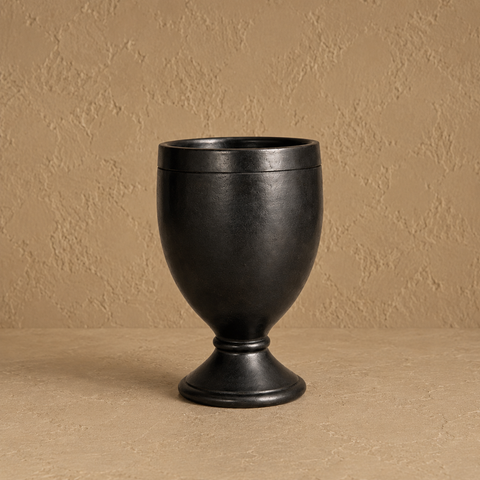
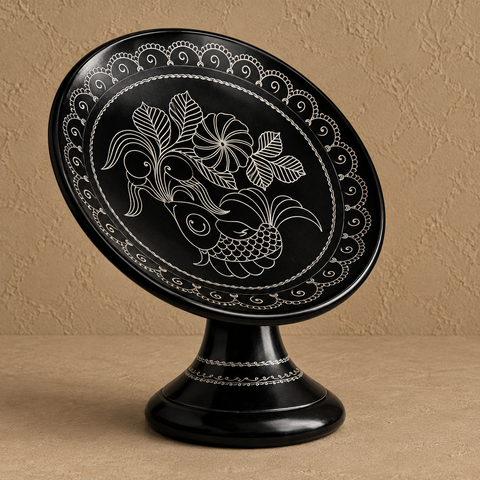
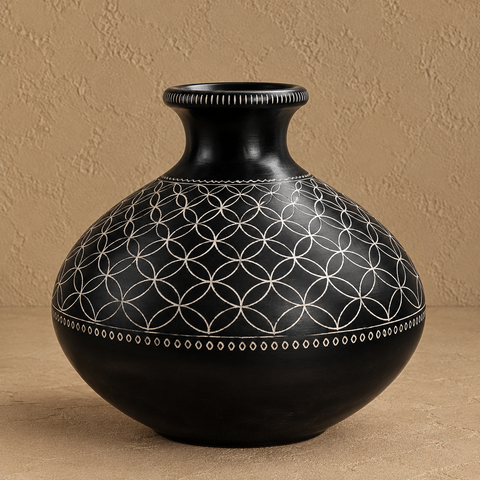
In the celebrated tradition of Nizamabad Black Pottery from Azamgarh, this elemental harmony reaches its highest expression. Here, Prajapati artisans employ a centuries-old reduction-firing technique that transforms ordinary clay into lustrous black pottery adorned with intricate silver-grey engravings.
The result is not merely a handcrafted object, but a living demonstration of elemental balance.
What Are the Pancha Bhuta?
The concept of Pancha Bhuta originates from the Taittiriya Upanishad and the Samkhya school of philosophy.
Unlike the classical Western elements, the Indian system includes a fifth and more subtle element—Akasha (Space or Ether)—the boundless field from which all existence emerges.
The word:
Together, they describe the complete structure of material reality.
The Five Elements and Their Qualities
Each element possesses distinct qualities and influences different aspects of life.
Prithvi (Earth)
Earth represents:
-
Stability
-
Solidity
-
Structure
-
Endurance
It is associated with the sense of smell and forms the physical foundation of all living things.
Within the human body, Earth governs:
-
Bones
-
Muscles
-
Tissues
-
Physical strength
Jal (Water)
Water represents:
-
Fluidity
-
Adaptability
-
Nourishment
-
Cohesion
It is connected to the sense of taste and governs all bodily fluids.
Water supports:
-
Blood circulation
-
Lymphatic function
-
Hydration
-
Emotional flow
Agni (Fire)
Fire symbolizes:
-
Transformation
-
Energy
-
Metabolism
-
Intelligence
Associated with the sense of sight, Fire governs digestion, vitality, and the body's ability to transform one state into another.
Vayu (Air)
Air represents:
-
Movement
-
Expansion
-
Breath
-
Communication
Linked to the sense of touch, it governs every form of movement in the body, from circulation to nerve impulses.
Akasha (Space)
Space is the most subtle element.
It represents:
-
Openness
-
Potential
-
Emptiness
-
Possibility
Associated with the sense of hearing, Akasha provides the container within which all other elements can exist and interact.
The Pancha Bhuta in Ayurveda and Yoga
The Five Elements form the basis of Ayurveda, India's ancient science of healing.
The three doshas arise from combinations of these elements:
-
Vata = Air + Space
-
Pitta = Fire + Water
-
Kapha = Earth + Water
Every individual possesses a unique elemental balance known as Prakriti.
Ayurvedic treatments, diets, and lifestyle practices seek to restore harmony among these elements.
Pancha Bhuta in Yoga
In Yoga, elemental balance is cultivated through various practices:
The chakra system also reflects the Five Elements:
| Chakra |
Element |
| Muladhara (Root) |
Earth |
| Svadhisthana (Sacral) |
Water |
| Manipura (Solar Plexus) |
Fire |
| Anahata (Heart) |
Air |
| Vishuddhi (Throat) |
Space |
Pottery: The Only Art Form That Unites All Five Elements
Among all forms of human creativity, pottery stands apart.
No other craft depends so directly and sequentially upon every element of the Pancha Bhuta.
Each stage of the process corresponds to one of the five elemental forces.
Earth: The Foundation of Form
Every vessel begins with Prithvi.
The artisan selects clay from carefully chosen sources, often riverbeds, ponds, or mineral-rich deposits.
In Azamgarh, Prajapati artisans use local clay known for its ideal composition and workability.
At this stage, the material is simple earth.
Yet within it lies limitless potential.
Water: The Enabler of Shape
Without Jal, clay cannot be shaped.
The potter adds water carefully until the clay reaches the perfect consistency.
Too little water causes cracks.
Too much causes collapse.
As the wheel spins, water allows the clay to respond gracefully to the artisan's hands.
It becomes the bridge between imagination and reality.
Air: The Silent Curer
Once formed, the vessel enters the domain of Vayu.
The drying process cannot be rushed.
Over days or weeks, air slowly removes moisture from the clay and stabilizes its structure.
In Nizamabad, artisans traditionally air-dry their pottery in shaded spaces where wind and temperature work naturally.
Patience becomes essential.
The potter must trust the element of Air to complete its work.
Fire: The Great Transformer
If Earth gives form and Water enables creation, Agni provides transformation.
The kiln is where ordinary clay becomes permanent pottery.
The fragile vessel enters the fire and emerges stronger, harder, and enduring.
The Magic of Nizamabad Black Pottery
What makes Nizamabad pottery unique is its traditional reduction-firing process.
After the initial firing:
-
The kiln is sealed.
-
Organic materials are introduced.
-
Oxygen levels are reduced.
-
Smoke becomes trapped inside.
This carbon-rich environment transforms the clay surface into a deep lustrous black.
The process permanently alters the pottery's structure and appearance.
The fire does not destroy the clay.
It elevates it.
Space: The Gift of Purpose
The most overlooked element is Akasha.
Yet it may be the most important.
A vessel's true value lies not in its walls but in the empty space it contains.
Without that hollow interior:
-
A vase cannot hold flowers.
-
A cup cannot hold tea.
-
A pot cannot store grain.
-
A bowl cannot serve food.
The emptiness gives purpose.
Space transforms an object into a vessel.
It is the final element that completes the creation.
The Pancha Bhuta in Vastu Shastra and Home Design
The principles of Vastu Shastra are deeply rooted in the Pancha Bhuta.
Each direction of a home corresponds to a specific element:
| Direction |
Element |
| Northeast |
Water |
| Southeast |
Fire |
| Southwest |
Earth |
| Northwest |
Air |
| Center (Brahmasthan) |
Space |
A balanced home seeks harmony among all five elements.
Handcrafted pottery naturally embodies this balance because it is born from the complete interaction of the Pancha Bhuta.
Unlike factory-made decor, handmade pottery carries the story of the elements that created it.
The Spiritual Significance of Elemental Balance
Across Indian spiritual traditions, mastery of the elements is considered essential for personal growth and liberation.
The Five Elements appear throughout:
-
Hindu philosophy
-
Ayurveda
-
Yoga
-
Jainism
-
Buddhism
-
Vastu Shastra
The potter, in many ways, becomes a student of these forces.
They cannot force the clay.
They cannot rush the wind.
They cannot fully control the fire.
Instead, they learn to collaborate with nature.
This patience, humility, and surrender transforms pottery into more than a craft.
It becomes a form of elemental meditation.
Bringing Elemental Harmony into Your Home with Hands of Craft
If the philosophy of the Pancha Bhuta resonates with you—whether through yoga, Ayurveda, spirituality, or mindful living—few objects embody these principles as completely as handcrafted pottery.
At Hands of Craft, every piece of Nizamabad Black Pottery reflects the journey of all five elements.
Each vase, mug, bowl, planter, and decorative vessel has been:
✓ Formed from Earth
✓ Shaped with Water
✓ Dried by Air
✓ Transformed through Fire
✓ Given purpose through Space
Created by Prajapati artisans using techniques passed down through generations, these pieces are more than home décor.
They are expressions of elemental balance.
They are fragments of living heritage.
They are reminders that everything in existence—including ourselves—is shaped by the same five sacred forces.
To place one of these vessels in your home is to invite the harmony of the Pancha Bhuta into your daily life.
A quiet reminder of the profound connection between nature, craftsmanship, and the universe itself.