In Hindu mythology, Vishwakarma is revered as the divine architect and master craftsman of the universe—the celestial creator responsible for building magnificent cities, forging divine weapons, and shaping the very structures that support the cosmic order.
Yet his legacy is not confined to mythology.
It lives on through countless artisan communities across India who continue to create with their hands, preserving traditions that have endured for centuries.
Among them are the Prajapati artisans of Nizamabad, Azamgarh, custodians of the renowned Nizamabad Black Pottery tradition. Their craft, recognized with a Geographical Indication (GI) Tag in 2015, reflects a living connection between divine inspiration and human craftsmanship.
This is the story of Vishwakarma, the patron deity of artisans, and how his creative spirit continues to thrive through one of India's most remarkable pottery traditions.
Vishwakarma: The Divine Architect of the Universe
The name Vishwakarma translates to "The Maker of All."
In Hindu tradition, he is regarded as the supreme architect, engineer, designer, and craftsman of the cosmos.
He is often depicted with four arms holding:
-
A water pot
-
A sacred book
-
A noose
-
Craftsman's tools
Together, these symbolize wisdom, creation, knowledge, and mastery over material form.
According to the Rig Veda, Vishwakarma was the divine force responsible for designing the heavens, the earth, and everything that exists between them.
His role extends far beyond architecture.
He is the celestial engineer who transforms divine vision into tangible reality.
The Legendary Creations of Vishwakarma
Throughout Hindu scriptures, Vishwakarma is credited with some of the most extraordinary creations ever described.
Dwarka: The City of Krishna
Vishwakarma designed the legendary city of Dwarka, the kingdom of Lord Krishna.
Built with divine precision, the city was said to possess unparalleled beauty, grandeur, and engineering excellence.
Indraprastha: The Palace of the Pandavas
In the Mahabharata, Vishwakarma is celebrated as the architect behind the magnificent palace of the Pandavas.
The structure was so extraordinary that its illusions and reflections bewildered visitors and enemies alike.
It demonstrated not only architectural brilliance but mastery over perception itself.
Lanka: The Golden City
According to the Ramayana, Vishwakarma created the magnificent city of Lanka, later ruled by Ravana.
Its golden palaces and advanced construction techniques made it one of the most celebrated cities in Hindu mythology.
Divine Weapons of the Gods
Vishwakarma's creations extended beyond cities and palaces.
He forged many of the gods' most powerful weapons, including:
-
Vajra — Indra's thunderbolt
-
Trishula — Shiva's trident
-
Sudarshana Chakra — Vishnu's divine discus
These creations highlight his role as both architect and celestial engineer.
Vishwakarma in Hindu Scriptures
The stories of Vishwakarma appear throughout:
-
The Vedas
-
The Puranas
-
The Ramayana
-
The Mahabharata
Across these texts, he serves as the divine problem-solver—the being entrusted with creating whatever is necessary to maintain cosmic balance.
Whether building cities, crafting weapons, or designing celestial vehicles, Vishwakarma represents the sacred union of creativity, skill, and purpose.
His mythology elevates craftsmanship from labor to a divine act of creation.
Vishwakarma Puja: A Celebration of Craftsmanship
Every year, artisans, craftsmen, engineers, mechanics, and industrial workers across India celebrate Vishwakarma Puja.
Observed primarily in September, the festival honors the divine architect and seeks his blessings for prosperity, skill, and success.
Honoring the Tools of Creation
On Vishwakarma Puja:
-
Workshops are cleaned and decorated.
-
Tools and machinery are worshipped.
-
Factories pause operations for prayers.
-
Artisans express gratitude for their craft.
The celebration reflects a powerful belief:
Tools are not merely instruments. They are extensions of the creative spirit itself.
The festival serves as a reminder that every act of making carries sacred significance.
The Prajapati Community: Guardians of a Living Legacy
The Prajapati community of Nizamabad, Azamgarh, embodies this philosophy through their dedication to pottery.
For generations, these artisans have preserved the unique tradition of Nizamabad Black Pottery, passing knowledge and techniques from one family member to the next.
For many Prajapati artisans, pottery is not simply a profession.
It is a responsibility.
A cultural inheritance.
A sacred continuation of a creative lineage that connects them to Vishwakarma himself.
Nizamabad Black Pottery: The Divine Mandate in Clay
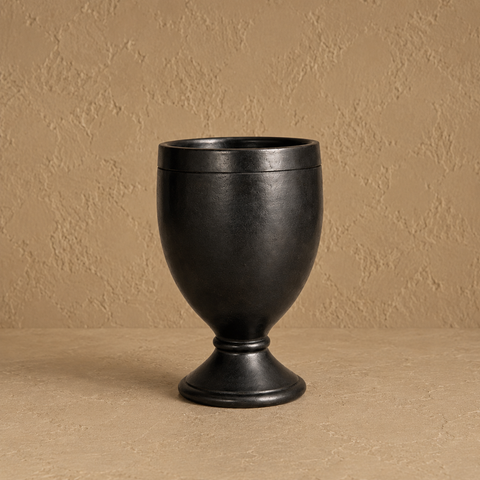
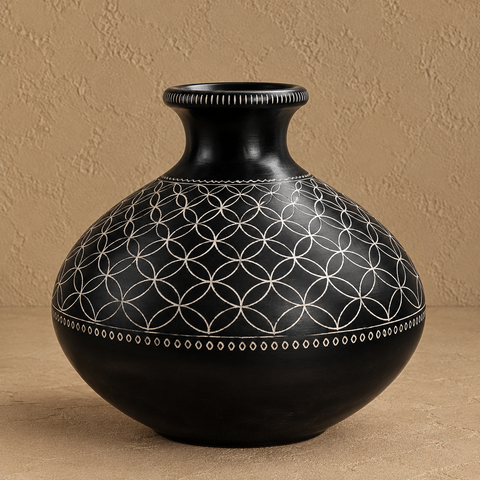
Among India's many pottery traditions, Nizamabad Black Pottery stands apart for its striking appearance and highly specialized production process.
Its signature features include:
-
Deep lustrous black surfaces
-
Intricate silver-grey engravings
-
Handcrafted forms
-
Traditional firing methods
Each piece reflects both artistic beauty and technical mastery.
The Journey from Clay to Art
The creation process begins with locally sourced clay collected from ponds and suitable deposits around the region.
The artisan then:
-
Prepares and refines the clay.
-
Shapes the vessel on the potter's wheel.
-
Hand-carves intricate patterns.
-
Air-dries the pottery carefully.
-
Fires it inside a specially prepared kiln.
The motifs often draw inspiration from:
Every mark is created by hand.
Every detail carries the signature of the artisan who made it.
The Magic of the Black Finish
The most remarkable transformation occurs during firing.
The pottery is placed inside a sealed kiln along with organic materials such as rice husks and other carbon-producing matter.
As oxygen levels decrease, smoke becomes trapped within the kiln.
This reduction-firing process creates a carbon-rich atmosphere that transforms the clay into its iconic black color.
The result is entirely natural.
No paint.
No industrial coating.
Only clay, smoke, fire, and time.
Craftsmanship as a Sacred Act
The connection between Vishwakarma and Nizamabad Black Pottery is not merely symbolic.
Both celebrate the same principle:
Creation as a sacred act.
Just as Vishwakarma shaped divine cities and celestial objects, the Prajapati artisan transforms raw earth into objects of beauty, utility, and meaning.
Each vessel becomes more than pottery.
It becomes a continuation of a story that stretches across generations.
A story of skill, patience, and devotion.
Bringing the Divine into Your Home
The philosophy of Vishwakarma reminds us that craftsmanship is not only about making objects.
It is about preserving culture, honoring tradition, and creating with intention.
At Hands of Craft, every piece of Nizamabad Black Pottery carries this spirit forward.
Whether it is:
-
A decorative vase
-
A serving bowl
-
A planter
-
A handcrafted diya
-
A statement décor piece
Each creation represents generations of accumulated knowledge and artistic excellence.
More than a decorative object, it is a connection to India's living craft heritage.
A reminder that true craftsmanship is timeless.
Made by hand.
Meant to stay.
And inspired by the same creative spirit that Hindu tradition celebrates through Vishwakarma—the divine architect whose legacy continues to shape the world through the hands of artisans.